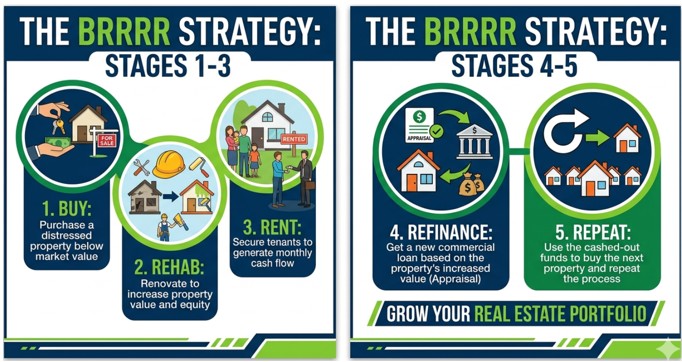
The BRRRR method (Buy, Renovate, Rent, Refinance, Repeat) is a powerful real estate strategy for building a property portfolio with limited capital.
Strict Bank Negara Malaysia (BNM) rules, early settlement penalties, and reduced loan margins for your third property mean you must adapt the framework to the local market.
When executed correctly, a Modified Malaysian BRRRR Strategy allows you to force equity growth through sub-sale properties and recycle your capital into a scalable rental business.
You cannot rely on capital appreciation to save a bad deal. You must make your profit when you buy. In Malaysia, skip new launch projects (under-construction properties) and focus strictly on the sub-sale market—specifically auction properties or distressed, outdated terrace houses and older condominiums in mature urban hubs like the Klang Valley, Penang, or Johor Bahru.
The 70% Rule
To insulate yourself from market risks, apply a strict buying formula adjusted for local closing costs (such as legal fees and the Real Property Gains Tax - RPGT). Your maximum purchase price must factor in your projected After-Repair Value (ARV) based on recent local bank valuations.
Maximum Purchase Price =(ARV X 0.70)-Estimated Renovation Costs)
For example, if a property valuer confirms that fully upgraded units in a specific Cheras apartment block are valued at RM400,000 (your ARV), and your contractor estimates cosmetic upgrades at RM50,000, your calculation is:
Maximum Purchase Price =(RM400,000 X 0.70)-RM50,000 = RM230,000)
Your acquisition price must not exceed RM230,000 to protect your equity buffer.
Local Buying Rules
Do not treat a rental property like your own home. Avoid expensive, customized interior designs. Instead, focus entirely on durable, modern upgrades that maximize space utility and attract high-paying tenants.
High-ROI Upgrades in Malaysia
[Total Capital Investment Checklist]
Purchase Price (90% Loan = 10% Down Payment Cash)
Renovation & Furnishing Budget
Legal Fees, Valuation Fees & Stamp Duty (MOT)
Securing a tenant is a mandatory milestone before a Malaysian bank will approve a long-term cash-out refinance. Lenders require an active tenancy agreement with proof of rental income to calculate your Debt Service Ratio (DSR).
Optimizing the Rental Strategy
The Refinance phase is where the Malaysian model differs completely from the Western version. You must navigate strict local bank restrictions to extract your capital successfully.
Step 1: Wait out Bank Lock-In Period (usually 3 years) to avoid 2%-3% exit penalty.
Step 2: Submit application using Stamped LHDN tenancy agreements to boost your DSR.
Step 3: Bank awards Cash-Out Refinance up to 90% of new valuation.
🛑 CRITICAL BNM RULE: The Cash-Out portion is capped at a maximum 10-year tenure.
Surviving the Refinancing Hurdles
Once your refinance goes through, the bank releases the equity as cash into your account. Take that extracted cash, account for your transaction expenses, and deploy it as the down payment for your next undervalued property.
To repeat this system smoothly without ruining your bank profile:
📊 Summary of the Malaysian BRRRR Process
| Phase | Core Action | Key Malaysian Constraint / Target |
|---|---|---|
| Buy | Purchase an undervalued sub-sale asset | Stick to sub-sale or auction; aim for a 90% margin |
| Renovate | Force equity and rental demand | Use LVP flooring; consider high-yield room partitions |
| Rent | Secure high-yield cash flow | Move to room rentals; get LHDN stamping for the lease |
| Refinance | Cash-out the forced equity | Wait out the 3-year lock-in; plan for the 10-year cash-out cap |
| Repeat | Deploy the capital into the next deal | Monitor your DSR; consider transitioning to a Sdn Bhd |
The Modified Malaysian BRRRR strategy requires patience and rigorous financial math. By understanding local banking constraints and shifting to high-yield rental strategies, you can safely recycle your capital and scale a profitable property portfolio.
Ad content here
Ad content here